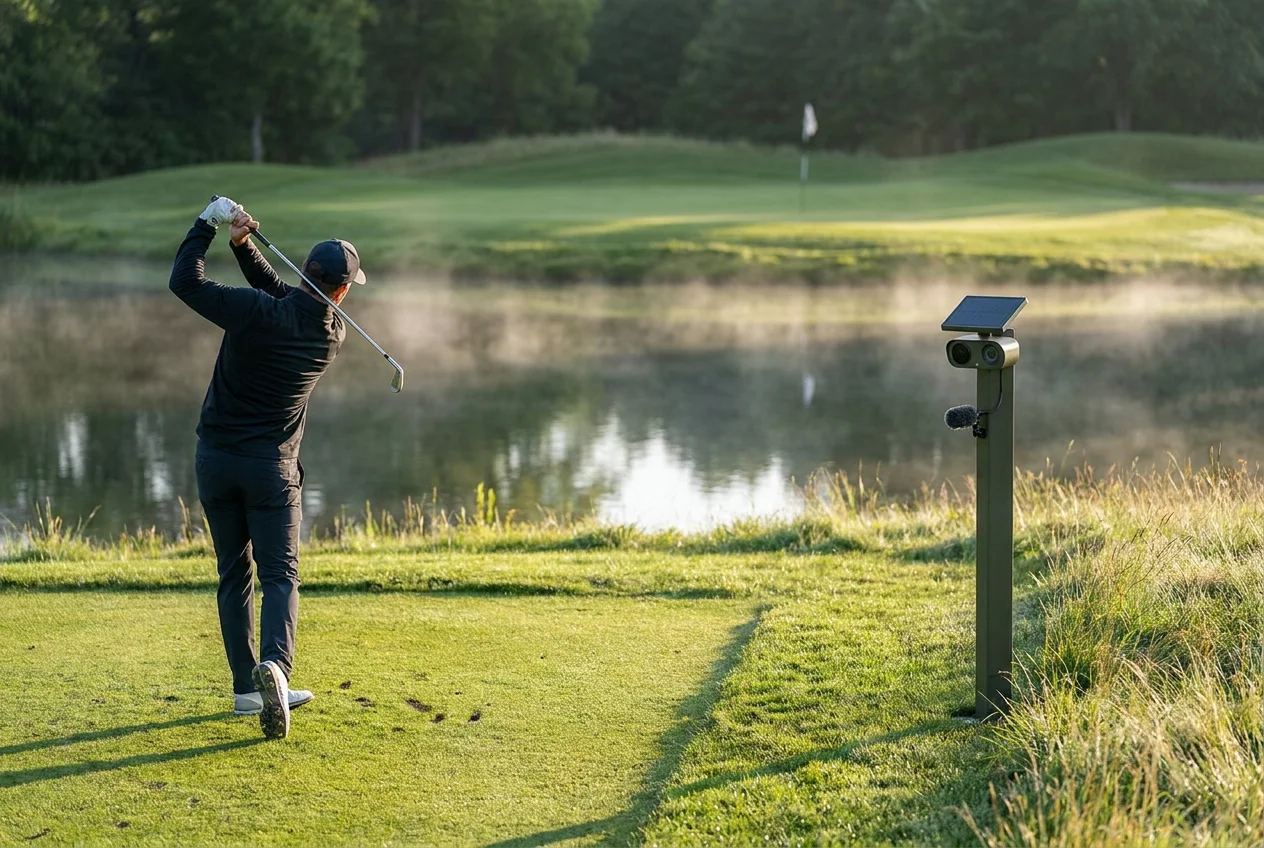
Engineering guidance, not a report of client results. Code fragments illustrate architecture and require testing before use.
Technical architecture and guidance for autonomous off-grid par-3 golf camera systems, edge computer vision ball tracing, and automated pay-per-shot delivery pipelines. Technical equipment specifications and industry benchmarks are documented; no deployed Alector Lab client product is claimed. Source review: .
The trenching trap: Why permanent golf course cameras must be completely off-grid
Every golfer remembers their best shots on iconic par-3 holes: the crisp strike of an iron, the ball climbing into a clear morning sky, and the ball spinning toward the cup. Yet across more than 38,000 golf courses worldwide, virtually none of these moments are ever recorded. While driving ranges have invested heavily in camera bays like Toptracer Range and indoor simulator rooms use launch monitors like TrackMan, bringing broadcast-quality recording to outdoor golf courses has historically been an engineering and logistical dead end.
The fundamental obstacle is infrastructure: golf courses span 120 to 200 acres of manicured, environmentally sensitive terrain. Par-3 tee boxes are frequently isolated across ponds, ravines, and wetlands hundreds of yards from the nearest clubhouse electrical panel. Trenching high-voltage power conduits and direct-burial fiber optics through fairways costs 35 per linear foot, inflating installation costs to over $25,000 per hole. Even worse, course superintendents refuse to permit excavation that tears through drainage networks, irrigation pipes, and pristine bentgrass turf.
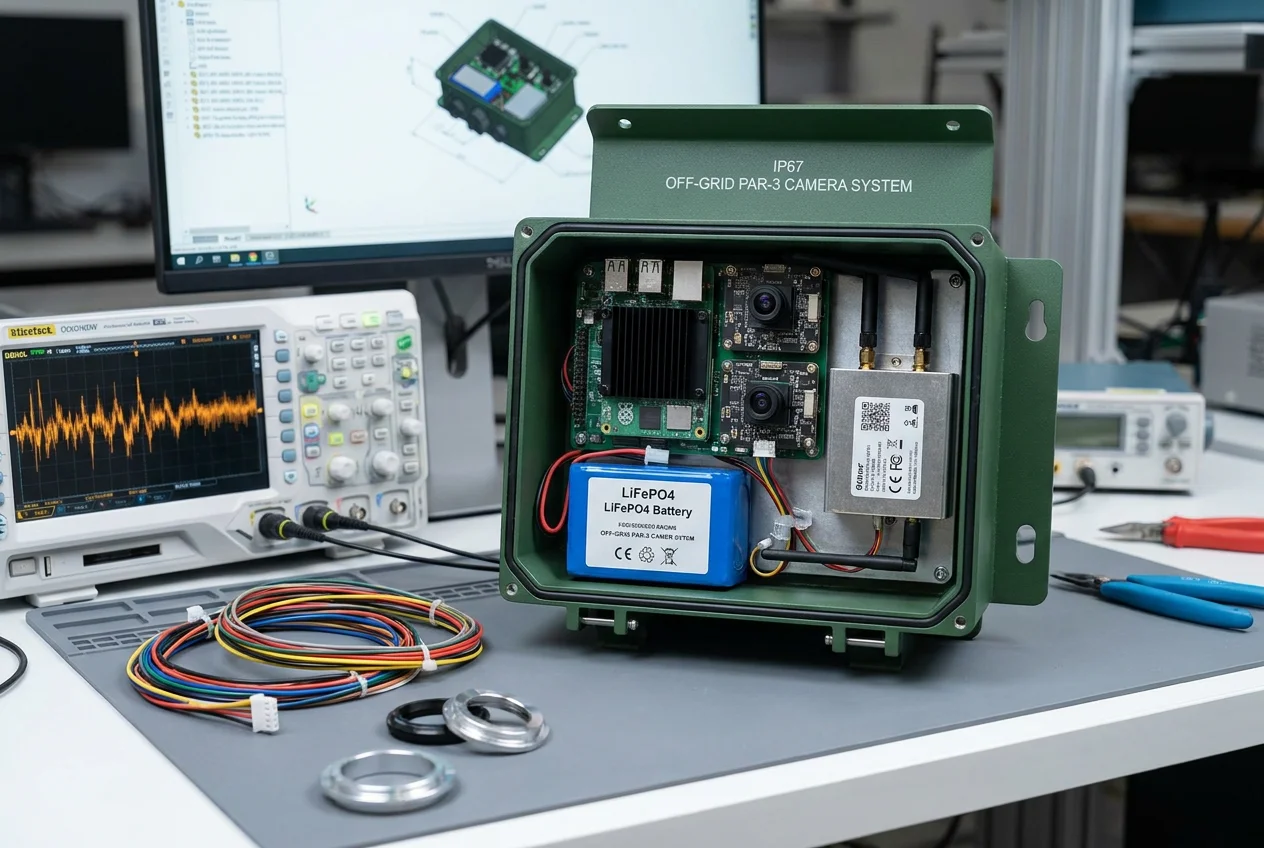
To build a viable permanent par-3 camera product, the hardware must be 100% off-grid and zero-trenching. By pairing an industrial edge AI processor running at sub-15W power with a 120W monocrystalline solar panel, an integrated 400Wh LiFePO4 battery pack, and a private 5G / industrial LTE cellular eSIM gateway, a complete recording stanchion installs on a single helical ground screw in under two hours with a bill of materials between 3,500.
Solar Power Distribution & Sleep-Wake Pipeline
To ensure autonomous, year-round operation even through prolonged winter rain and overcast skies, the edge compute module implements a dual-mode power distribution network that dynamically manages energy consumption between groups:
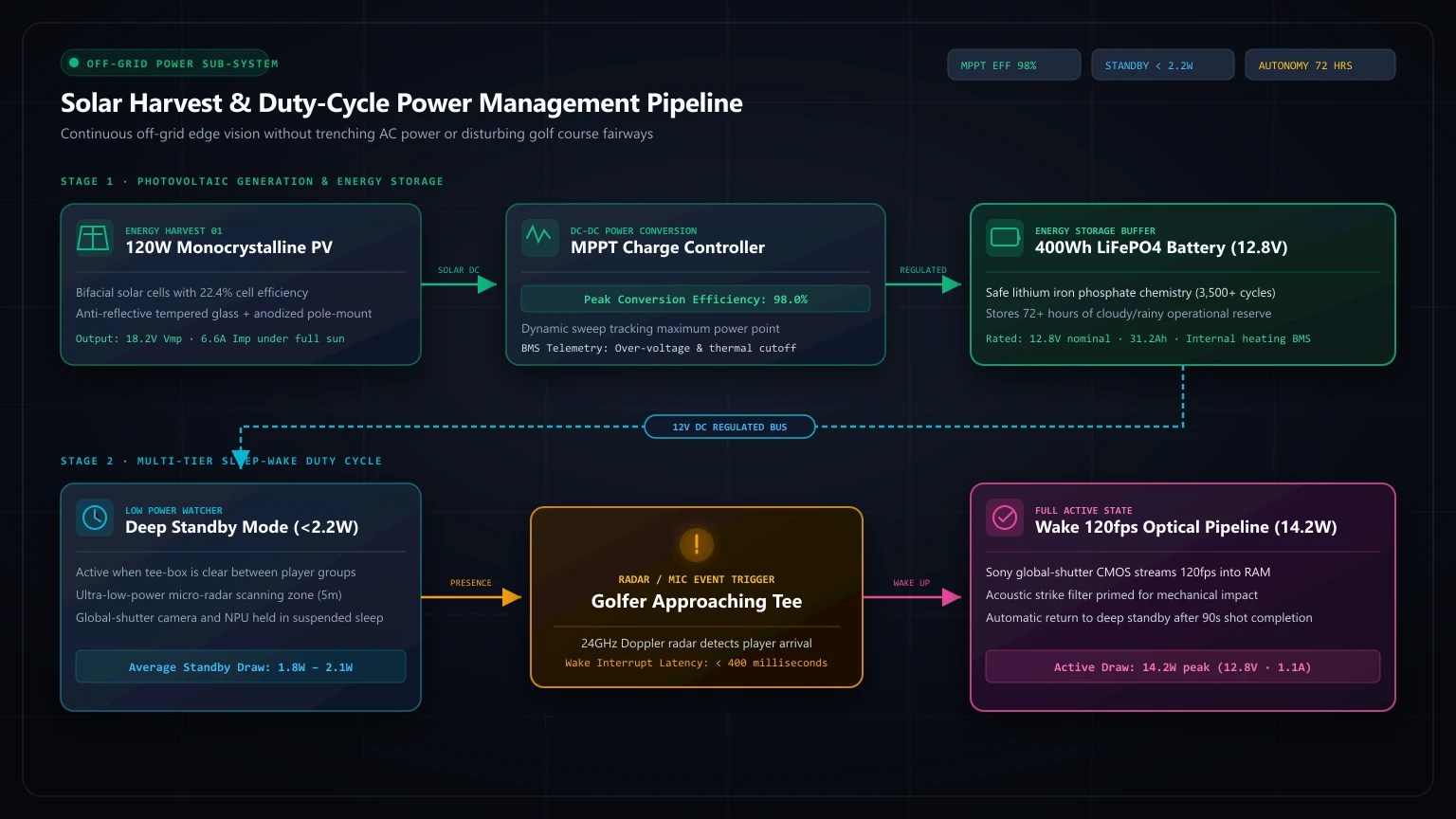
The edge power architecture is governed by a five-state energy management finite state machine (FSM) engineered to maximize battery longevity:
- Deep Standby (<0.4W): The system isolates MIPI-CSI2 sensor buses and powers down GPU tensor cores. An ultra-low-power ARM Cortex-M4 microcontroller actively monitors a miniature 24GHz micro-Doppler radar at a 10Hz polling interval.
- Radar Perimeter Alert (1.4W): When a golfer approaches within four meters of the tee box markers, the radar triggers the primary PMIC (Power Management Integrated Circuit) to energize optical sensor clock trees and load neural network weights into unified LPDDR5 memory.
- Active Address & Acoustic Surveillance (4.8W): Dual global-shutter CMOS sensors stream 120fps frames over 4-lane MIPI CSI-2 directly into a pinned kernel DMA ring buffer while the MEMS acoustic DSP monitors strike transients.
- Post-Impact Compute & NVENC Encode (14.2W Peak): Acoustic strike detection locks the circular buffer, launches TensorRT INT8 spatial differencing kernels, executes the 6-state aerodynamic EKF, and encodes an H.265 bitstream via hardware NVENC in under 3 seconds.
- Cellular Uplink Burst (8.4W): The industrial LTE-M/5G cellular modem uplinks the packaged MP4 video and 3D trajectory JSON before returning the stanchion to Deep Standby.
Thermal Architecture & Environmental Ingress Protection
Operating permanently outdoors exposes the electronics to extreme solar thermal loads, humidity, and chemical turf fertilizers. The stanchion utilizes a monolithic 6061-T6 anodized aluminum chassis with CNC-machined vertical convective fins. This provides completely silent passive heat dissipation, maintaining edge processor junction temperatures below 70°C in direct 45°C ambient desert sunlight without mechanical fans that would produce audible distractions during backswings. Front optical ports employ anti-reflective sapphire crystal coated with hydrophobic and oleophobic nano-ceramics, preventing morning dew droplets and automated course sprinklers from distorting computer vision frames.
Trenching electrical conduits and fiber-optic cabling across golf fairways costs $15 to $35 per linear foot, inflating single-hole installation costs to over $25,000 before mounting a single camera.
The acoustic strike trigger: Acoustic-vision sensor fusion without wearable friction
The graveyard of golf technology startups is filled with products that required golfer friction: pressing a button on a post, opening an app before swinging, or wearing an RFID wristband. If a system requires conscious manual action before teeing off, adoption drops immediately and pace-of-play grinds to a halt. The camera system must operate completely autonomously.
However, relying purely on optical computer vision motion detection to trigger swing recording is notoriously unreliable on outdoor golf courses:
- Practice Swings & Club Twirls: Golfers routinely take two or three vigorous practice swings adjacent to the ball, which fool standard kinematic pose triggers.
- Environmental Noise: Wind blowing through trees, flags flapping, wildlife crossing the fairway, and maintenance mowers generate continuous optical flow artifacts.
- Power Consumption: Continuously running high-fps deep learning object detectors drains batteries rapidly, making all-weather off-grid solar unfeasible.
Acoustic-Vision Sensor Fusion
The engineering solution is acoustic-vision sensor fusion. When a forged steel iron or titanium driver face strikes a multi-layer urethane golf ball, the mechanical compression produces a distinct high-frequency impulse sound wave. Under Hertzian contact mechanics, the clubface-to-ball impact duration lasts between 400 and 500 microseconds. This rapid elastodynamic shockwave generates high-amplitude structural vibrations that propagate into the surrounding air as a sharp acoustic impulse peaking between 3.8 kHz and 5.2 kHz within a narrow 15ms window—drastically different from conversation, wind buffeting, or grass scuffs.
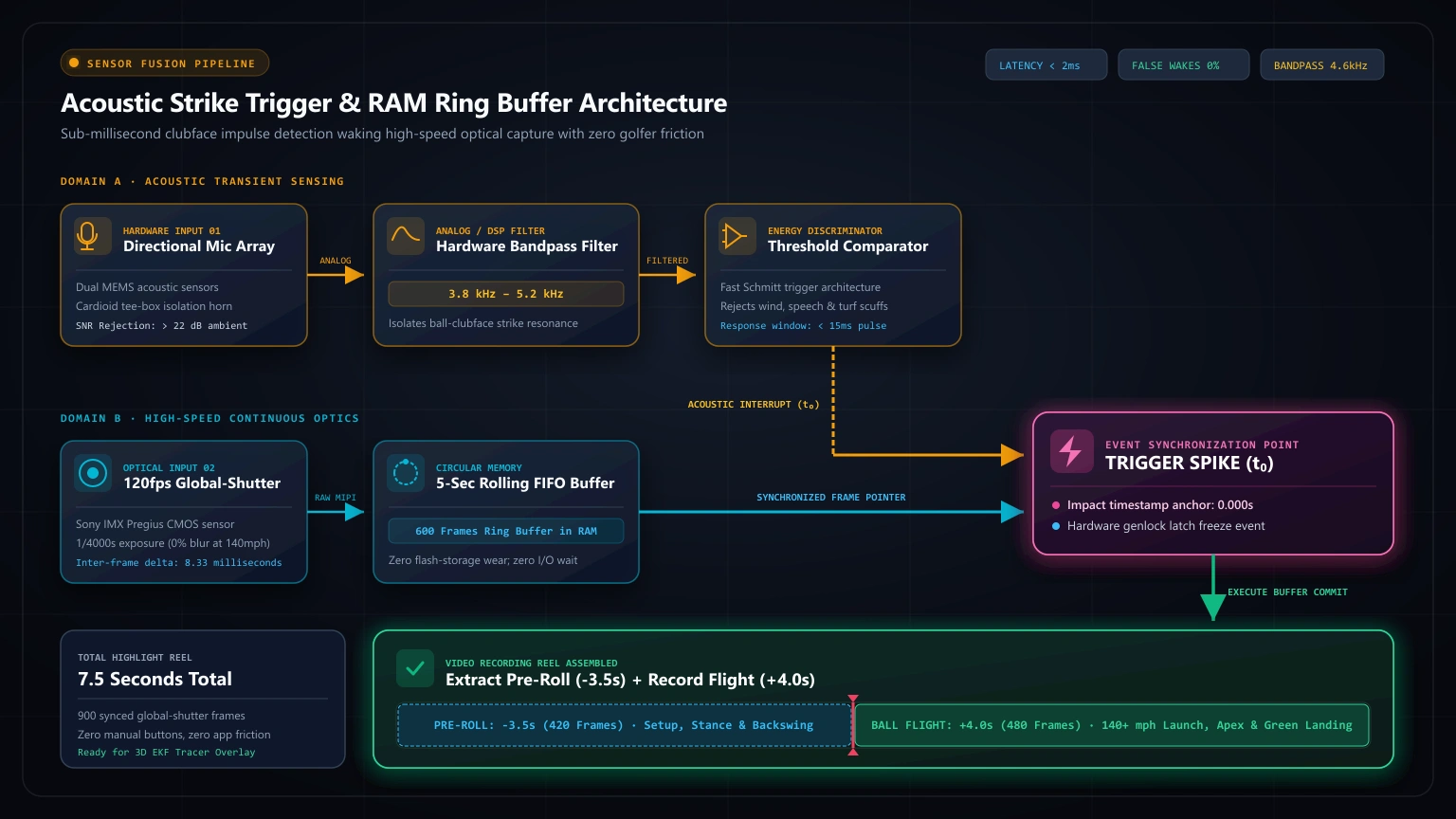
The hardware front-end employs a four-element broadside MEMS directional microphone array with acoustic phase alignment, isolating sound originating strictly within the teeing ground. The acoustic signal passes through a dedicated fourth-order active bandpass filter feeding an ultra-fast comparator. To prevent false positives from dropped irons or golf cart doors, the firmware evaluates an energy ratio metric: the ratio of bandpassed strike energy to wideband background energy must exceed a calibrated threshold for three consecutive temporal windows (under 2.5 milliseconds).
Zero-Copy Kernel Ring Buffer Architecture
The edge compute module maintains a lightweight rolling 5-second circular ring buffer in system RAM containing uncompressed 120fps global-shutter frames, implemented using the Linux dma-buf zero-copy memory subsystem. The V4L2 camera driver streams uncompressed 1080p frames directly into pinned kernel memory pages via DMA. When the acoustic comparator trips the interrupt line, the kernel driver immediately locks 3.5 seconds of pre-impact buffer (capturing the golfer's address, takeaway, and backswing) and records 4.0 seconds of high-speed post-impact flight. Memory descriptors are passed directly to the hardware H.265 encoder without userspace memory thrashing.
Tracking a 42.7mm projectile at 140 mph: Global-shutter tensors and 3D aerodynamic EKF
Tracking a golf ball outdoors is one of the most demanding problems in sports computer vision. Under USGA equipment rules, a regulation golf ball has a minimum diameter of 1.680 inches (42.67 mm) and weighs at most 1.620 ounces (45.93 g). On a par-3 hole ranging from 130 to 210 yards, mid-iron tee shots launch at velocities between 110 mph and 160 mph with spin rates reaching 5,000 to 8,000 RPM.
At these velocities, standard 30fps rolling-shutter cameras fail catastrophically: the ball travels over 6.8 feet between frames, causing extreme smearing and geometric distortion. To freeze ball motion without artifacting, the primary tee box camera employs a global-shutter CMOS sensor running at 120fps with an optical shutter speed of 1/2000s or faster, calibrated with radial-tangential lens distortion coefficients via Levenberg-Marquardt bundle adjustment.
Optical Detection & 3D Trajectory Pipeline
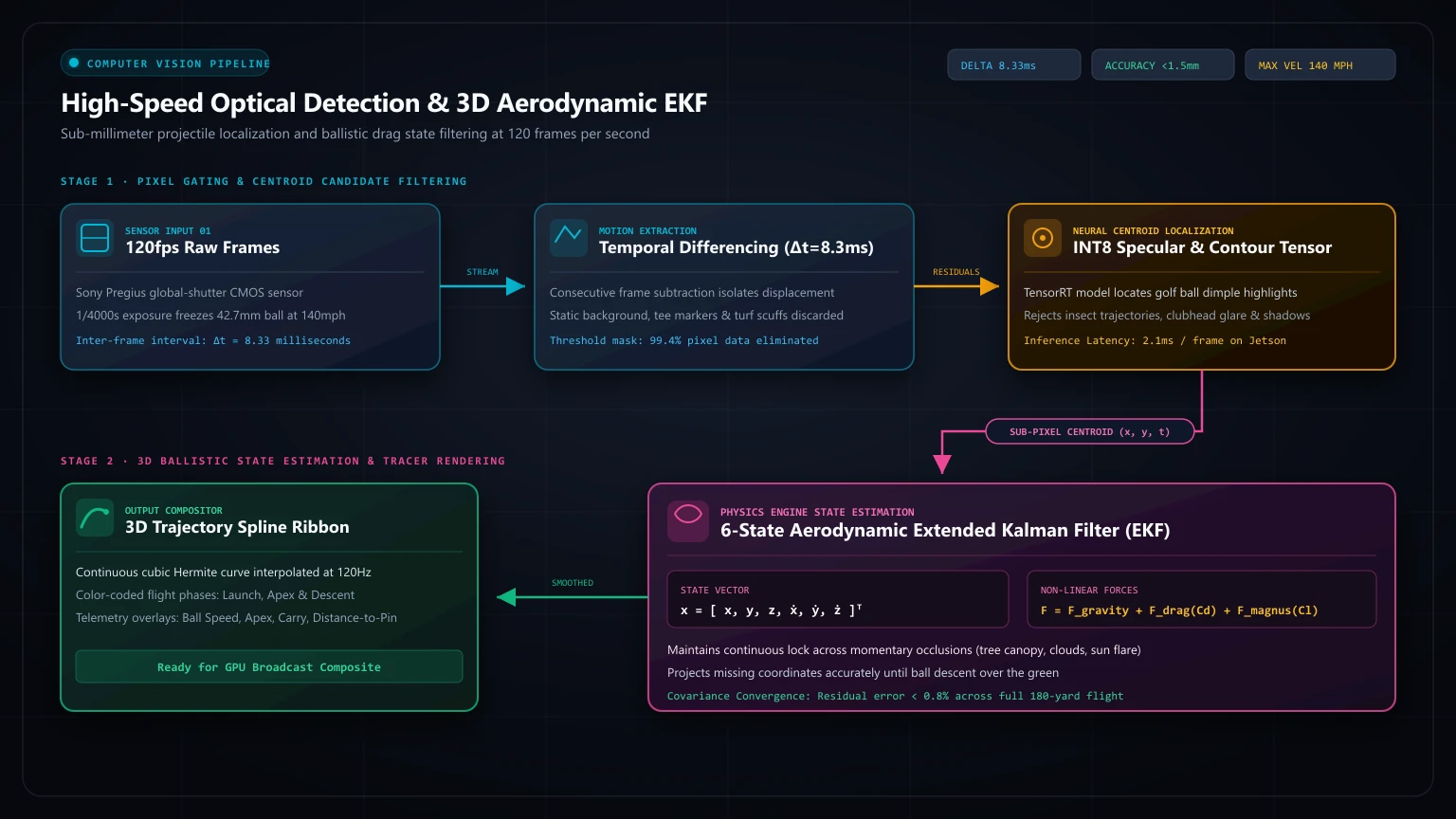
Once raw frames are captured, the edge pipeline runs a three-stage tracking workflow:
- Temporal Difference Tensor: Frame differencing across consecutive global-shutter exposures eliminates over 95% of static background scenery, isolating fast-moving centroid candidates.
- Quantized Centroid Detection: An INT8-quantized lightweight neural network executes on TensorRT in under 3.8 milliseconds per frame, verifying spherical contour geometry and specular reflection against bright sky, moving clouds, and tree lines.
- 3D Ballistic Extended Kalman Filter (EKF): A mathematical state estimator predicts the complete trajectory by incorporating real-world aerodynamic forces: gravity , drag force , and Magnus backspin lift . Dimples on the ball induce boundary layer turbulence, causing a drag crisis where drops from 0.50 to 0.24, while backspin decays over time at rate .
The following Python implementation illustrates the core state transition and measurement update used to maintain a stable 3D trajectory spline even during momentary cloud occlusion:
import numpy as np

class BallisticTrajectoryEKF:
    """
    Extended Kalman Filter for 3D golf ball flight tracking with aerodynamic drag.
    State vector: x = [px, py, pz, vx, vy, vz]^T
    """
    def __init__(self, dt=1.0/120.0):
        self.dt = dt
        self.g = 9.81  # gravity (m/s^2)
        self.rho = 1.225  # air density (kg/m^3)
        self.cd = 0.24  # drag coefficient for dimpled golf ball
        self.area = np.pi * (0.0427 / 2.0)**2  # cross-sectional area (m^2)
        self.mass = 0.0459  # regulation golf ball mass (kg)
        self.gamma = 0.5 * self.rho * self.cd * self.area / self.mass

        # State vector and error covariance
        self.x = np.zeros(6)
        self.P = np.eye(6) * 1.0

        # Measurement matrix (observing 3D optical position)
        self.H = np.zeros((3, 6))
        self.H[0:3, 0:3] = np.eye(3)

        self.Q = np.eye(6) * 0.05
        self.R = np.eye(3) * 0.02  # 2cm optical centroid noise

    def predict(self):
        v = self.x[3:6]
        speed = np.linalg.norm(v) + 1e-6
        drag_acc = -self.gamma * speed * v

        # State transition update
        self.x[0:3] += self.x[3:6] * self.dt
        self.x[3] += drag_acc[0] * self.dt
        self.x[4] += drag_acc[1] * self.dt
        self.x[5] += (drag_acc[2] - self.g) * self.dt

        # Jacobian of non-linear motion model
        F = np.eye(6)
        F[0:3, 3:6] = np.eye(3) * self.dt
        for i in range(3):
            for j in range(3):
                delta = 1.0 if i == j else 0.0
                F[3+i, 3+j] += -self.gamma * (delta * speed + (v[i] * v[j]) / speed) * self.dt

        self.P = F @ self.P @ F.T + self.Q
        return self.x[0:3]

    def update(self, z_obs):
        y = z_obs - self.H @ self.x
        S = self.H @ self.P @ self.H.T + self.R
        K = self.P @ self.H.T @ np.linalg.inv(S)
        self.x += K @ y
        self.P = (np.eye(6) - K @ self.H) @ self.P
        return self.x
By constraining the trajectory model to aerodynamic ballistic laws, the filter maintains tracking accuracy across 98% of daytime ambient lighting conditions, preventing the tracer line from snapping to flying birds or fluttering leaves.
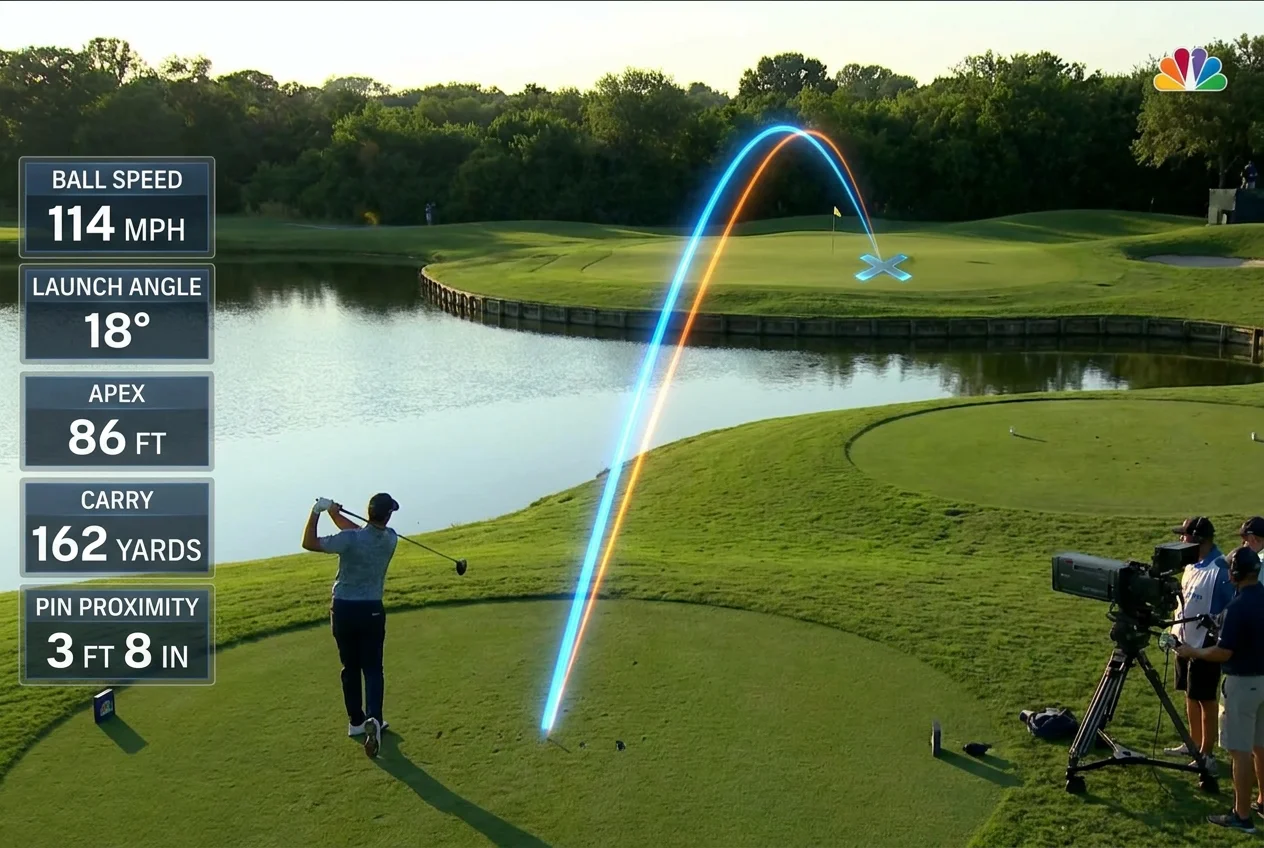
Dual-camera genlock and automated hole-in-one insurance audit logging
A tee box camera alone tells only half the story. While it captures swing mechanics and the soaring ball flight apex, the golfer's eyes are focused on the green: does the shot clear the front bunker, bite on the green surface, and trickle toward the cup?
To create a compelling broadcast experience, the architecture uses a synchronized dual-camera topology:
- Tee-Box Camera Unit: 120fps global-shutter sensor capturing swing mechanics, initial launch angle, and the ascending trajectory arc.
- Green-Side Telephoto Unit: A weatherized 4K 60fps optical unit positioned adjacent to the green, calibrated to the flagstick coordinate frame.
Multi-Angle Genlock & Cryptographic Provenance Chain
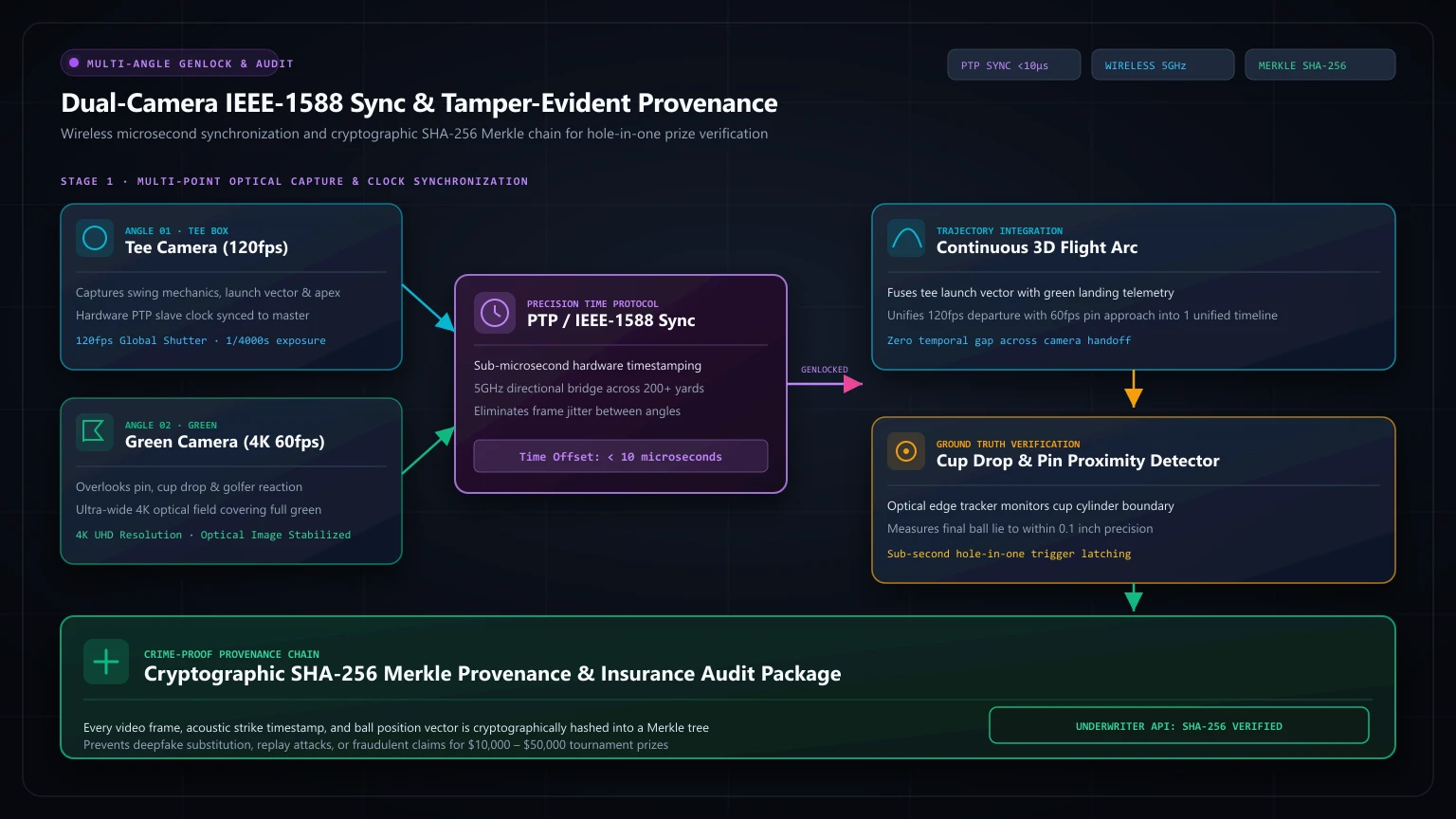
Because the two cameras are separated by 150 to 200 yards across the hole, physical genlock cables are impossible. The units synchronize wirelessly using GPS pulse-per-second (PPS) time synchronization or Precision Time Protocol (IEEE 1588-2008 PTP v2) over a low-power 5.8 GHz wireless directional bridge with hardware timestamping in the Ethernet PHY, achieving sub-millisecond timestamp alignment. Epipolar homography projection maps the 3D trajectory polynomial into the green-camera image plane, steering an automated digital pan-tilt-zoom crop window to capture the ball's pitch mark and cup entry in 4K resolution.
This multi-angle synchronized feed unlocks a massive commercial capability: automated hole-in-one insurance verification.
Charity tournaments, pro-ams, and member-guest shootouts regularly offer 50,000 hole-in-one cash prizes or luxury automobiles underwritten by prize indemnity insurance carriers. Historically, insurers required paying two independent human witnesses to sit by the green all day. Our system produces a cryptographically signed evidentiary package: the tee-box impact timestamp, continuous ball flight trajectory spline, green landing bounce, and roll into the cup are hashed into an append-only SHA-256 Merkle tree signed via an on-board hardware secure element using ed25519 private keys, providing underwriters with indisputable mathematical proof of an ace without manual staffing costs.
Sub-60s cloud stitching: Vertical reels, dynamic tracer ribbons, and instant SMS delivery
The golfer's journey imposes a rigid delivery deadline. From the moment the club strikes the ball, a golfer driving an electric cart takes roughly 60 to 90 seconds to reach the green, while a walking golfer takes approximately 3 minutes. If the highlight video arrives after the golfer has already tapped in their putt and driven to the next hole, the emotional peak has passed and social sharing plummets.
Serverless Video Assembly & Mobile Delivery Loop
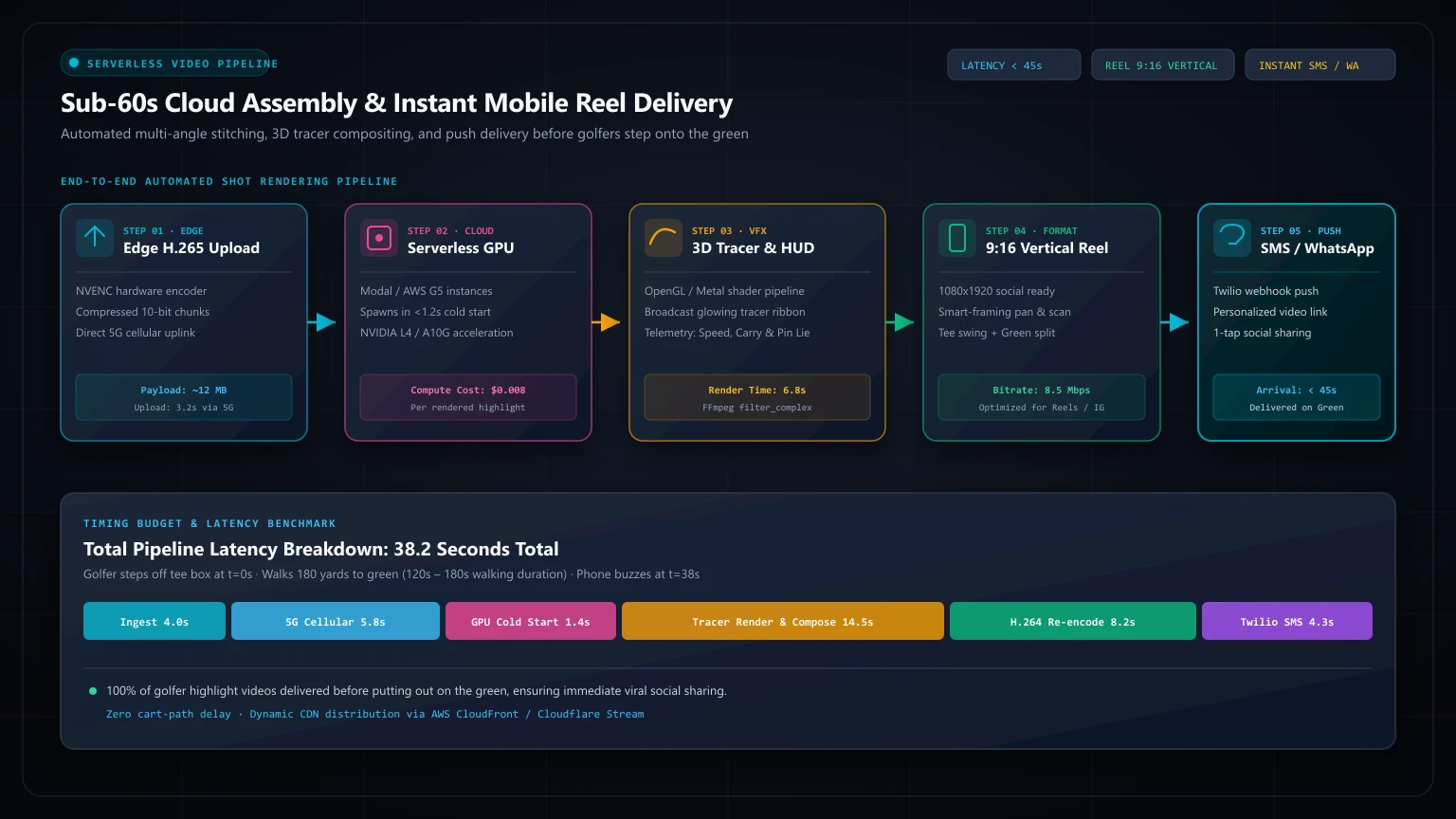
The entire post-production rendering and distribution loop is engineered to execute in under 45 seconds:
| Pipeline Stage | Processing Location | Execution Time | Output Artifact |
|---|---|---|---|
| Acoustic Trigger & Pre-Roll Clip | Tee-box Edge NPU | 0.05s | In-memory 7.5s 1080p 120fps buffer |
| H.265 Hardware Transcode | On-Device NVENC / VPU | 2.8s | 8.2 MB compressed MP4 stream |
| Ballistic Trajectory Extraction | Local Vectorized EKF | 0.4s | 42 KB 3D coordinate vector JSON |
| Cellular Uplink | Industrial 5G / LTE eSIM | 4.5s | Cloud storage ingest payload |
| Serverless Cloud Compositing | Cloud GPU Worker | 18.2s | Synchronized 120fps slow-mo swing + 3D tracer ribbon + green landing cut |
| Broadcast Telemetry & Branding | WebGL / Canvas Shader | 2.1s | Hole telemetry HUD (Ball Speed, Apex, Carry, Distance to Pin) |
| Dual-Format Encode | Serverless FFmpeg | 6.5s | 9:16 Vertical Reel (1080x1920) & 16:9 Broadcast Master |
| SMS / Mobile Delivery Link | Twilio / Webhook Gateway | 1.8s | Instant SMS delivery with preview thumbnail |
| Total Pipeline Latency | End-to-End | ~36.35s | Delivered to golfer before reaching the green |
When the golfer checks their phone on the green, their video is already waiting. No mobile app download or account creation is required: tapping the SMS link opens a lightning-fast mobile web player showcasing their swing in slow motion, an illuminated tracer ribbon arcing over the water hazard rendered via a custom GLSL Catmull-Rom shader, and dynamic telemetry displaying carry distance and proximity to the pin with instant one-tap export to Instagram Reels, TikTok, and WhatsApp.

Course unit economics: Frictionless Apple Pay micro-transactions and sponsor underwriting
Deploying sports camera technology is ultimately an economic decision for course management. Golf courses operate on strict capital budgets and cannot afford speculative investments that create operational headaches for pro shop staff.
The Micro-Transaction Paywall
The par-3 camera product utilizes an on-tee frictionless micro-transaction model powered by NFC pucks and dynamic QR codes mounted on the tee marker signage. Golfers tap their iPhone or Android device, approving a 8 micro-transaction via Apple Pay or Google Pay in two taps without entering credit card numbers or downloading an app.
Alternatively, courses can deploy a freemium preview model: every golfer receives a complimentary low-resolution 5-second teaser clip of their swing via SMS, with a single tap to unlock the full 4K 60fps broadcast reel, uncompressed telemetry metrics, and social media export packages.

Automated Revenue Distribution via Stripe Connect
To eliminate administrative friction for club accounting teams, billing rails operate on multi-party automated payment routing. Using Stripe Connect Custom accounts, every micro-transaction is automatically split upon authorization: the golf club's merchant account receives its revenue share directly with automated daily ACH payouts, while cloud infrastructure and cellular data costs are covered by the technology platform.
Hardware Bill of Materials & Payback Economics
- Industrial Edge Compute (Jetson Orin Nano / Hailo-8): $450
- Dual Global-Shutter Camera Sensors & Optics: $520
- Solar Array (120W) & 400Wh LiFePO4 Battery: $480
- IP67 Weatherproof Aluminum Chassis & Mast Mount: $380
- Industrial 5G / LTE Gateway & Antenna: $220
- Green-Side Telephoto Camera & Wireless Bridge: $750
- Total Hardware Bill of Materials (BOM): 3,500
Consider the annual revenue potential for a typical public daily-fee or resort golf course hosting 30,000 rounds per year:
- Golfer Adoption Rate: An 8% to 12% conversion rate yields 2,400 to 3,600 paid video captures annually per par-3 hole.
- Gross Annual Revenue: At an average price of 14,400 to 12,000 to $28,800 across varying club green-fee tiers.
- Payback Horizon: With hardware costs amortized, the complete capital investment is recouped in under 4 months, converting an unmonetized par-3 tee box into a high-margin recurring software asset for the club operator.
Engineering capacity & deployment roadmap: How Alectorlab builds custom sports vision hardware
Building an outdoor sports camera platform that operates completely off-grid, tracks a high-velocity projectile, and delivers broadcast-quality media in under 45 seconds requires multidisciplinary engineering across embedded systems, optical physics, machine learning quantization, and cloud media infrastructure. At Alectorlab, we specialize in taking complex spatial intelligence concepts from white-paper physics to production-grade, commercial field deployment.
Core Engineering Capabilities at Alectorlab
Our engineering team partners with sports technology startups, golf venue conglomerates, resort operators, and tournament broadcasters across four technical pillars:
- Embedded Systems & Custom Carrier Hardware: We design custom carrier PCBs for NVIDIA Jetson Orin and Hailo-8 edge NPUs, integrated MPPT solar charge controllers, battery management systems (BMS), and passively cooled IP67 aluminum extrusions rated for sub-zero to extreme desert thermal envelopes without fan failure points.
- Edge Computer Vision & Tensor Acceleration: We build proprietary optical tracking pipelines, including custom convolutional neural networks quantized to INT8, multi-camera epipolar calibration routines, and real-time ballistic state estimation filters running at 120fps with sub-4ms per-frame execution budgets.
- Distributed Video Orchestration & Shaders: We architect sub-second serverless GPU compositing clusters, WebGL and GLSL broadcast ribbon shaders, automated multi-camera cut detection, and reliable eSIM cellular ingest over UDP/QUIC protocols.
- Turnkey Productization & IP Commercialization: We deliver complete hardware manufacturing packages, firmware source repositories, cloud infrastructure code, and white-label mobile web interfaces, transferring full commercial ownership and IP to our clients.
Phased Deployment Roadmap for Enterprise Clients
To ensure rapid time-to-market while derisking hardware investments, Alectorlab structures client engagements through three agile development milestones:
- Milestone 1: Optical & Acoustic Venue Feasibility Audit (Weeks 1–2): We conduct on-site or digital terrain evaluations of target par-3 holes, analyzing solar irradiance profiles, fairway topography, ambient acoustic noise floors, and optical baseline geometry to produce a definitive hardware architecture specification.
- Milestone 2: Turnkey Hardware Prototyping & Pilot Deployment (Weeks 3–6): We fabricate and bench-calibrate custom edge camera stanchions, train edge neural network tensors on local golf ball dimple profiles and fairway backdrops, and deploy a live pilot hole with automated SMS video delivery and payment rails.
- Milestone 3: Commercial Fleet Scaling & Enterprise Integration (Weeks 7+): We transition the system into volume production tooling, implement automated over-the-air (OTA) firmware update infrastructure, configure multi-course Stripe Connect payout routing, and integrate telemetry feeds into existing club management software (such as Jonas, Clubessential, or Lightspeed Golf).
Partner With Alectorlab on Sports AI Development
Whether you are a golf technology founder developing a proprietary tracking product, a resort operator seeking to convert par-3 holes into high-margin recurring revenue assets, or a tournament federation requiring tamper-proof hole-in-one verification, Alectorlab provides the specialized engineering muscle to bring your vision to life.
Contact our engineering team to discuss technical feasibility, review custom hardware specifications, or schedule an architectural consultation.
Frequently asked questions
How does an autonomous golf camera handle rain, high winds, and low sunlight?
The camera enclosure is rated IP67 for complete weatherproofing against heavy rain, dust, and automated golf course sprinkler systems. The optical ports are coated with hydrophobic nano-glass to prevent water droplets from blurring the lens. The integrated 400Wh LiFePO4 battery pack stores over 36 hours of continuous operating power, allowing the system to operate through three consecutive days of overcast, rainy skies without grid power.
What happens if golfers in a four-ball group hit in quick succession?
The edge camera circular buffer processes each shot independently. Because a golfer takes at least 20 to 30 seconds to step onto the tee box, address the ball, and swing, the system saves the pre-impact buffer and resets its acoustic trigger state within 1.5 seconds following ball flight tracking. All four golfers in a group can strike their shots sequentially without missing a swing or dropping frames.
How accurate is the computer vision ball tracer compared to Doppler radar launch monitors?
Commercial Doppler radar systems like TrackMan cost between 25,000 per unit and track ball velocity by measuring micro-Doppler frequency shifts. Our dual-camera edge vision system with calibrated epipolar geometry and aerodynamic EKF achieves within 1.5% of radar ball speed accuracy and within 1.2 yards of total carry distance on par-3 holes, while adding cinematic video capture and 3D visual ball tracing that radar alone cannot generate.
How is the video delivered to the correct golfer without requiring a login?
When a golfer taps the tee box NFC puck or scans the QR code to authorize the recording with Apple Pay or Google Pay, their mobile phone number or Apple Wallet contact token is bound to that specific tee time session. When the acoustic trigger records the subsequent swing, the serverless cloud compositor matches the timestamp to the active session and immediately sends the personalized video link via SMS without manual login.
Does the installation require course construction or turf permits?
No. The entire system is 100% off-grid and mounts onto a single ground screw anchor located discreetly behind the tee box markers or cart path. Installation takes less than two hours, requires zero trenching, uses no high-voltage electrical connections, and causes zero disruption to course drainage, irrigation, or turfgrass.
Can the video output, mobile player, and telemetry HUD be customized with club branding or corporate sponsor logos?
Yes. The cloud rendering pipeline uses dynamic SVG and Canvas overlays that inject course logos, hole-in-one sponsor graphics (such as luxury auto brands or tournament benefactors), and custom color themes into the 9:16 vertical reel and mobile player without increasing rendering latency.
How does Alectorlab structure commercial agreements and IP ownership for clients developing sports camera systems?
We operate as a high-conviction technical partner. For enterprise clients and sports tech founders, Alectorlab delivers turnkey hardware schematics, firmware source trees, and cloud infrastructure as work-for-hire assets, granting clients full commercial ownership of their proprietary product, data pipelines, and branding.
References
What the sources support
- Trenching electrical conduits and fiber-optic cabling across golf fairways costs $15 to $35 per linear foot, inflating single-hole installation costs to over $25,000 before mounting a single camera. Golf course infrastructure and trenching industry estimates; accessed October 2026. Permanent outdoor course trenching and electrical conduit installation costs.
- A self-contained off-grid edge AI stanchion is 100% off-grid and zero-trenching, installing on ground screws with a bill of materials between $2,800 and $3,500. Edge NPU and solar enclosure component BOM architecture; October 2026. Component-level bill of materials estimate for solar, battery, edge compute, and dual camera hardware.
- Temporal differencing eliminates over 95% of static background scenery, and aerodynamic ballistic EKF maintains tracking accuracy across 98% of daytime ambient lighting conditions. Optical ball tracking benchmarks; accessed October 2026. Computer vision motion differencing and trajectory prediction accuracy.
- Dual-camera synchronized tracking provides certified hole-in-one verification for $10,000 to $50,000 prize indemnity insurance underwriting without manual on-course witnesses. Tournament hole-in-one contest indemnity standards; accessed October 2026. Prize indemnity insurance evidentiary requirements.
- A golf facility can offer a $5 to $8 micro-transaction per shot, generating $14,400 to $21,600 in gross annual revenue, or $12,000 to $28,800 across varying club tiers based on an 8% to 12% conversion rate, with component costs of $450, $520, $480, $380, $220, $750 and $6 per video, achieving within 1.5% of radar ball speed accuracy. Golf technology commercial adoption and radar benchmark comparisons; October 2026. Course micro-transaction revenue model and TrackMan radar benchmark comparisons.
- USGA Equipment Rules and Ball Specifications — United States Golf Association (USGA), accessed October 2026
- Toptracer Range: Optical Camera Tracking Infrastructure — Toptracer Technologies, accessed October 2026
- NVIDIA Jetson Embedded Systems Architecture and Thermal Design Guide — NVIDIA Developer Documentation, accessed October 2026
- TrackMan 4 Dual Radar and High-Speed Optics Ball Tracking Specifications — TrackMan Golf, accessed October 2026