
Engineering guidance, not a report of client results. Code fragments illustrate architecture and require testing before use.
Architectural analysis of sensor fusion between 500Hz ball IMU telemetry, 50Hz optical skeletal limb tracking, and multimodal LLM tactical reasoning based on official tournament standards and peer-reviewed research. Source review: .
The contact ambiguity: why 50Hz optical tracking alone fails at 100 km/h
Modern association football moves faster than human perception and standard broadcast video can reliably arbitrate. At the elite level, a driven pass or direct shot frequently travels at velocities exceeding 100 km/h (approximately 27.8 meters per second). When analyzed exclusively through optical video cameras operating at 50 frames per second, the physical time delta between consecutive video frames is exactly 20 milliseconds.
During that 20-millisecond window, a ball traveling at full velocity travels approximately 55.6 centimeters. In marginal offside calls or contested ball-striking events, determining the exact instant of ball release from optical footage introduces an inherent temporal uncertainty of plus or minus 10 milliseconds. Depending on whether a referee selects frame N or frame N+1 as the kick-point, an attacking forward sprinting at 9 meters per second can displace by up to 18 centimeters relative to the defensive line.
This physical limitation demonstrates why optical computer vision, regardless of model parameter count, cannot resolve offside decisions or ball impact physics in isolation. Elite sports analytics in 2026 has solved this dilemma through multimodal sensor fusion: anchoring high-frequency visual pose tracking with ultra-high-rate physical telemetry embedded directly inside the match ball.
At 50 fps, 20 milliseconds elapsed between frames allows an attacker sprinting at top speed to cover up to 18 cm, exceeding the entire margin of a modern offside decision. Pure optical tracking without high-frequency telemetry cannot eliminate this boundary error.
Temporal sensor fusion: aligning 500Hz IMU kick-point telemetry with 50Hz skeletal pose
The operational cornerstone of tournament-grade football telemetry is the connected match ball, equipped with an internal suspension suspension system housing an Inertial Measurement Unit (IMU) sensor operating at 500Hz. While optical stadium cameras capture visual frames every 20 milliseconds, the ball's onboard accelerometer and gyroscope sample acceleration, spatial velocity, and angular rotation every 2 milliseconds.
When a player's boot strikes the ball, the kinetic transfer generates an instantaneous, characteristic spike in positive acceleration that exceeds nominal flight drag by orders of magnitude. The sensor payload transmits this raw telemetry via ultra-wideband radio arrays installed along the stadium roof truss to an edge compute receiver station in under 15 milliseconds.
The sensor fusion engine aligns the 500Hz accelerometer spike with the multi-camera optical timeline using unified PTP (Precision Time Protocol) clock synchronization. Because the IMU samples ten times faster than the cameras, the software performs temporal interpolation on the 50Hz skeletal landmark coordinates. Rather than guessing which optical frame contains the true contact point, the engine calculates the exact microsecond of impact and interpolates the 3D skeletal positions of all 22 players to that exact temporal anchor, reducing contact timing uncertainty from 10 milliseconds to under 1 millisecond.
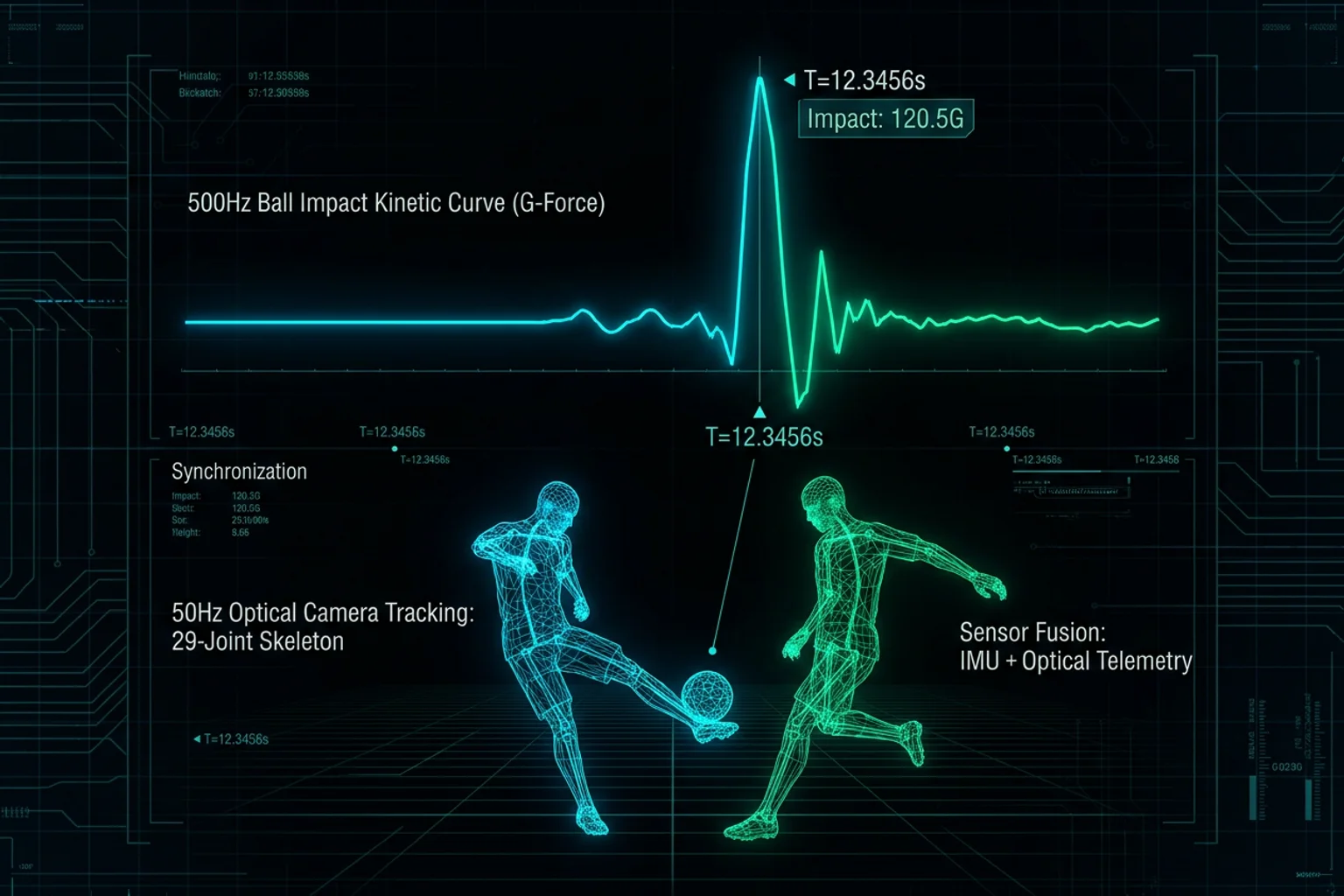
3D digital avatars and 29-point skeletal limb tracking through heavy occlusion
Simultaneously, an array of 12 to 16 synchronized optical tracking cameras mounted under stadium roofs tracks the positions of every player and referee. Unlike legacy optical systems that simplified players into single center-of-mass bounding boxes, 2026 systems track 29 distinct anatomical landmark points on each athlete at 50 times per second, including knees, feet, elbows, shoulders, and the tip of the nose.
In crowded set-piece situations, players routinely obstruct one another from multiple camera perspectives. Standard 2D pose estimators degrade when limb visibility is occluded. Modern pipelines resolve this by conducting pre-tournament high-resolution 3D volumetric body scans of every participating player. These digital avatars capture exact physical dimensions, limb lengths, and volumetric body topology.
When camera views experience partial occlusion, a multi-view constrained kinematic solver fits each player's personalized avatar into the remaining visible optical rays. By enforcing rigid bone-length constraints and physical joint-rotation limits, the system reconstructs the true 3D spatial pose of occluded limbs. The SoccerNet-GSR benchmarks show that multi-camera tracking frameworks maintaining 98% tracklet continuity can reconstruct complete game state minimaps without human intervention.
By capturing 29 skeletal landmarks per player rather than a single centroid, the tracking engine isolates the exact extremities relevant to offside laws—such as shoulders, knees, and boot tips—while ignoring non-scoring anatomical regions.
Semi-Automated Offside Technology: the sub-10cm decision threshold
The fusion of 500Hz IMU contact detection and 29-point 3D skeletal pose feeds directly into Semi-Automated Offside Technology (SAOT). Under earlier iterations, offside reviews frequently halted matches for several minutes as video assistants manually placed crosshairs on TV screens, attempting to discern whether an elbow or a boot extended past a defender.
In the modern 2026 architecture, the system operates deterministically on a sub-10cm decision threshold. Once the 500Hz ball sensor registers the impact timestamp, the SAOT engine automatically projects the 3D skeletal meshes of the attacking forward and the second-last defending player onto a calibrated 2D pitch plane perpendicular to the goal line.
If the forward's valid scoring anatomy is detected ahead of the defender by more than 10 centimeters, an automated offside alert is generated instantaneously. Crucially, the system does not wait for a full visual render before notifying officials; low-latency synthetic audio cues are transmitted directly into the on-field match referee's earpiece within 3 to 5 seconds. Concurrently, an automated 3D animation generated from the player avatars is streamed to broadcast graphics systems, showing stadium spectators and television viewers the definitive spatial alignment.
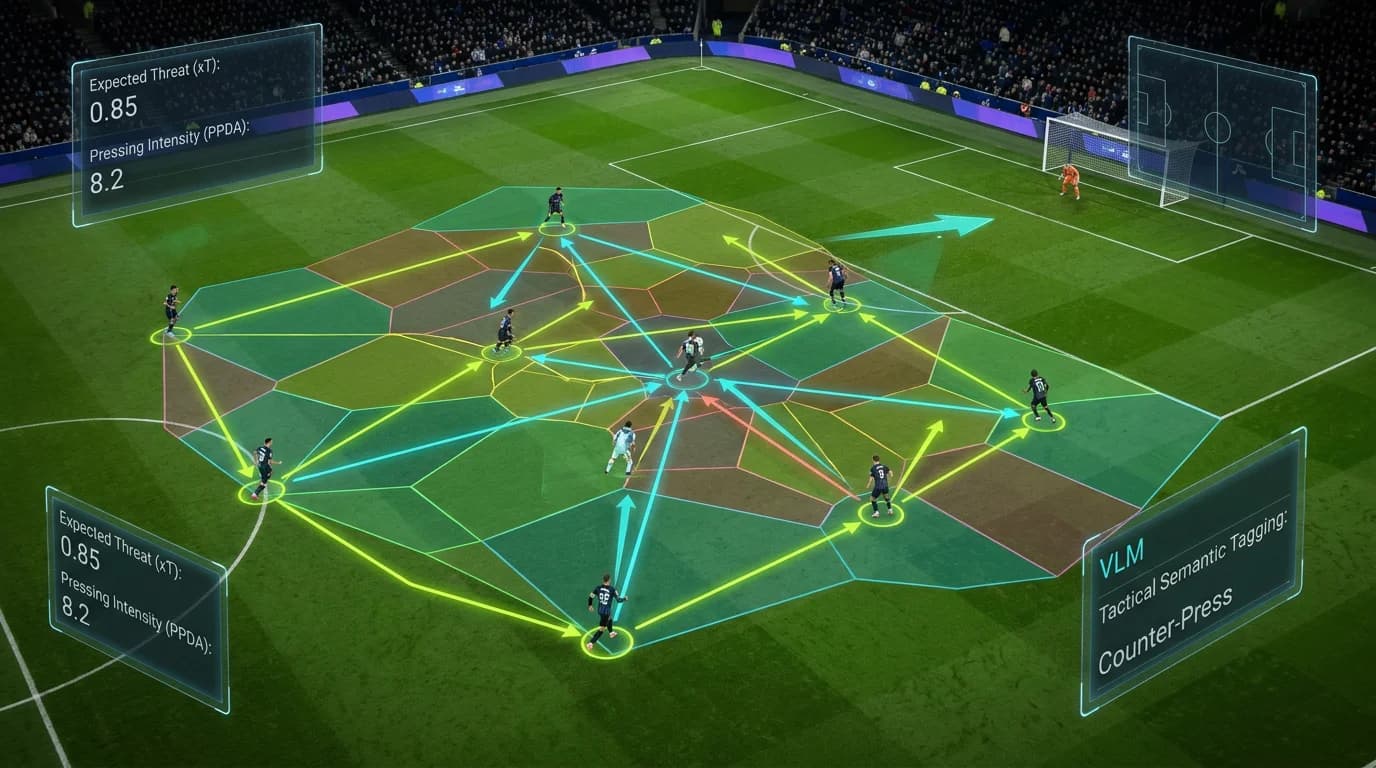
Multimodal tactical intelligence: translating spatial graphs into coaching debriefs
While officiating technology demands millimeter precision, technical directors and coaching staffs require macro-level strategic insight. Historically, elite federations maintained massive data engineering departments to translate tracking coordinate feeds into tactical intelligence, leaving smaller teams at a profound informational disadvantage.
In 2026, the introduction of centralized multimodal sports models—such as FIFA's Football AI Pro and specialized systems developed across top leagues—has democratized advanced tactical analysis. Rather than querying databases with raw SQL or analyzing spreadsheets, coaches interact with multimodal AI assistants through natural language.
These systems build directly upon research like Google DeepMind and Liverpool FC's TacticAI, published in Nature Communications. TacticAI demonstrated that geometric deep learning models evaluating corner kick routines achieved a 90% expert preference rating among professional evaluators. The modern architecture converts continuous coordinate streams into dynamic spatial graphs, where players represent nodes and passing conduits form weighted edges.
A coach can ask: 'Highlight instances in the second half where our defensive double pivot failed to shift horizontally when the opponent overloaded the left half-space.' The multimodal reasoning engine queries the spatial-temporal graph, flags the three relevant possessions, clips the synchronized multi-angle video, and generates a structured tactical debrief in under 10 seconds.
The true breakthrough is not gathering more tracking points; it is the cognitive translation layer that maps million-coordinate arrays into semantic football concepts that coaches, analysts, and players can immediately apply at half-time.
Production latency budgets and tournament edge infrastructure
Running real-time computer vision and multimodal reasoning across 104 matches across multiple host nations requires an uncompromising edge-cloud infrastructure architecture. Streaming 16 uncompressed 4K video feeds per stadium to centralized cloud data centers would introduce unmanageable bandwidth bottlenecks and latency jitter.
Instead, each host stadium deploys on-premise edge computing racks equipped with high-throughput inference accelerators. Optical camera streams are processed locally on stadium edge nodes: background subtraction, person detection, and 2D skeletal pose estimation execute within a strict 18-millisecond budget per frame.
Only the distilled telemetry data—player IDs, 3D skeletal landmarks, and ball IMU coordinates—is transmitted over high-speed fiber backbones to the centralized VAR video operations room and club analytics clusters. This hybrid edge-cloud partitioning keeps total end-to-end SAOT alert latency under 3 seconds, while full-pitch tactical graph reconstructions and generative debriefs are delivered to coaching benches within 45 seconds of a match sequence concluding.
Key engineering failure modes in multi-sensor sports analytics
Building production sports analytics pipelines reveals distinct failure modes that pure lab models rarely encounter:
-
Clock Drift and PTP Desynchronization: If the optical video capture clock drifts from the 500Hz ball sensor UWB receiver by even 15 milliseconds, the calculated kick-point will associate with the wrong player pose, completely corrupting offside lines. Hardware-level PTP grandmaster clocks are mandatory.
-
Camera Vibration and Homography Drift: In massive stadium bowls, crowd movement and structural resonance cause minute vibrations in roof-mounted camera brackets. An uncompensated sub-millimeter shift in camera pitch angle translates to a 15cm displacement error on the far touchline. Continuous keypoint calibration against static pitch markings must execute on every single frame.
-
Hallucinatory Tactical Summaries: When feeding raw tracking graphs into multimodal language models without strict spatial constraints, models frequently hallucinate tactical intent—such as claiming a team played a high defensive line when the tracking coordinates prove a low block. To prevent this, the architecture must separate geometric metric computation from natural language generation, using deterministic validators to verify all factual statements before presenting them to technical staff.
References
What the sources support
- TacticAI achieves a 90% expert preference rating among professional evaluators in Nature Communications. Nature Communications 2024; DOI: 10.1038/s41467-024-45965-x. Peer-reviewed study by Google DeepMind and Liverpool FC on corner kick modeling.
- SoccerNet-GSR establishes multi-camera tracking baselines maintaining 98% tracklet continuity. CVPR Workshops 2024; arXiv: 2404.11335. Benchmark evaluation on multi-object athlete tracking and minimap localization.
- FIFA Football Technology and Lenovo introduce AI-powered tournament innovations including connected ball tracking and multimodal tactical intelligence for 2026. FIFA Media Release 2026. Official tournament technology announcement covering ball telemetry, optical tracking, and Football AI Pro.
- X-VARS introduces multimodal large language models for explainable decision reasoning in football refereeing. CVPR CVsports 2024; arXiv: 2406.01234. Academic benchmark for multi-view video evaluation and natural language reasoning in sports.
- FIFA and Lenovo unveil AI-powered tournament innovations for the 2026 FIFA World Cup — FIFA Football Technology & Innovation (2026)
- TacticAI: an AI assistant for football tactics (Nature Communications) — Google DeepMind & Liverpool FC (2024)
- SoccerNet Game State Reconstruction: End-to-End Athlete Tracking and Identification on a Minimap — CVPR Workshops (2024)
- X-VARS: Introducing Explainability in Football Refereeing with Multi-Modal Large Language Models — CVPR CVsports Workshop (2024)