Engineering guidance, not a report of client results. Code fragments illustrate architecture and require testing before use.
Engineering guidance based on official capability documentation, practitioner experiments, and sports-specific research; no Alector Lab benchmark or client result is claimed. Source review: .
A coach's question is rarely a model-shaped problem
“Show me every possession where we broke the press but lost the second ball.”
That sounds like one request. In practice, it is several jobs hiding inside a sentence. A system has to find the right possessions, identify the players, follow the ball through traffic, understand what “broke the press” means to this coaching staff, and return clips an analyst can check. A fluent paragraph is not enough. The evidence has to survive contact with the footage.
The short answer is that there is no single best model for sports video analytics in 2026. Gemini 3.8 Flash can explore video natively. GPT-6 Astra can reason deeply over selected images and structured context, but it does not accept video directly. Qwen3-VL offers an open-weight route for teams that need more control. Specialist detection, tracking, pose, calibration, and event models still do the frame-by-frame measuring.
The most useful system is usually a hybrid: use each model for the job it can actually do.
Consider a basketball possession. The ball disappears behind two players, a jersey number flashes into view, and the broadcast cuts before the pass. One layer locates the possession; others track the players, calibrate the court, and interpret the evidence. Was that the same player after the cut? The answer still needs timestamps, confidence, and source clips—not just prose.
That is why complete workflows matter more than one attractive test clip.
The practical comparison: choose by job
A vision-language model (VLM) connects visual evidence with language instructions and answers. The useful differences start with what evidence each one can receive.
| Model or approach | How it receives the game | Best fit in a sports workflow | What to test carefully |
|---|---|---|---|
| GPT-6 Astra | Selected images, crops, timestamps, and structured tracking context | Difficult visual interpretation, identity clues, and reviewable structured event records | Sampling gaps, latency, cost, and the absence of native video input |
| Gemini 3.8 Flash | Native video and audio, with adaptive exploration | Searching long footage, finding candidate moments, and producing a first-pass account | Fine temporal precision, missed brief events, and grounding every answer to evidence |
| Qwen3-VL | Video or prepared visual inputs in an open-weight stack | Private deployment experiments, customization, and timestamp-grounded prototypes | Infrastructure burden and performance on the club's own sports, cameras, and definitions |
| DeepSport / SportMV-Agent | Sports-focused research pipelines with active frame or view selection | Learning where domain-specific agents and benchmarks are heading | Research maturity; neither should be treated as a turnkey club product |
| Specialist vision models | Frames processed continuously | Detection, multi-object tracking, pose, ball trajectories, calibration, and measurable coordinates | Camera-specific validation, identity switches, occlusion, and training-data coverage |
Gemini's video documentation describes direct video understanding and an agentic mode that selects moments at different resolutions. It is a natural candidate for broad exploration: “Find the passages after our substitutions.” But locating a useful minute is not the same as measuring every sprint inside it.
Qwen3-VL offers open weights, video understanding, and timestamp grounding. That gives teams more deployment control, but serving, optimization, monitoring, and sports-specific evaluation become their responsibility.
Sports research such as DeepSport and SportMV-Agent points toward agents that choose frames or camera views. It is an important direction, but not yet a turnkey club product.
Where GPT-6 Astra is genuinely interesting
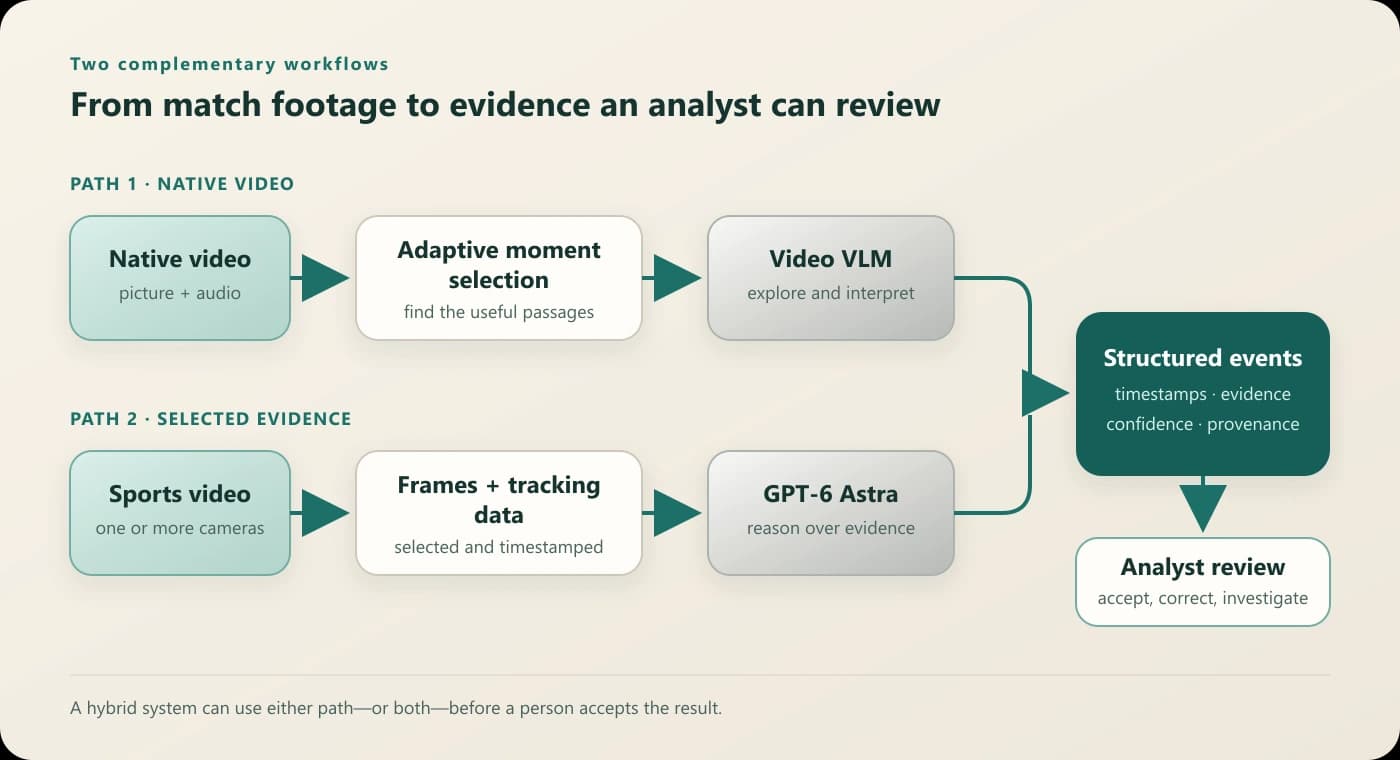
Start with the boundary that is easiest to miss. OpenAI's official model page lists image input as supported and video input as unsupported. Another system must first extract frames, crops, timestamps, transcripts, or tracking records.
Think of Astra as a selective reasoning specialist, not a replacement for the video pipeline: call it when the context justifies the latency and spend.
An early Roboflow tennis experiment shows the promise and the catch. Timestamped frames from a fixed-camera rally were sent to Astra with a strict event schema. At five frames per second, it identified serves, hits, points, and faults. Below four, one point was missed. An unseen bounce does not reappear because the reasoning is clever.
This was a vendor demonstration, not an independent benchmark. Its value is practical: sampling changes what the model can know.
A basketball builder experiment used the same division of labour. Specialist models handled detection, tracking, and court mapping; Astra handled selected re-identification, team-assignment, and jersey-reading questions. It is a prototype, not validated research, but the pattern is sensible: measure continuously and escalate difficult context.
Astra also supports structured outputs. A club can require each proposed event to include a timestamp, participants, evidence, confidence, and a reason for review. Analysts can correct records instead of untangling free-form commentary.
The evidence for GPT-6 Astra in sport is promising but early. None of the peer-reviewed sports papers cited in this article explicitly evaluates Astra, so “extensively researched” would overstate the current record.
Why the latest models still need help
Sports footage punishes confident shortcuts: a hidden bounce, players crossing during a pan, a jersey readable in one view, or legal contact that looks like a foul in slow motion.
SportR tests fine-grained spatial, temporal, and tactical sports reasoning. RefereeBench tests rule application: across 925 videos and 6,475 questions in 11 sports, its reported best result was around 60 percent; Qwen3-VL scored 47 percent. These are benchmark-specific figures, but they warn against confusing a persuasive explanation with a correct decision.
SportMV research reports that current models struggle to select and combine useful camera views. A robust system needs synchronization, provenance, and a way to admit that the decisive angle was missing.
What a buyer should test before choosing a model
Begin with analyst questions, not a leaderboard. Test the clean tactical camera, the rainy night match, the occluded baseline, the broadcast cut, and the low-resolution archive.
- Evidence: Does every event link back to the relevant clip, frame, camera, and timestamp?
- Missed-event behaviour: Does the system say “insufficient evidence,” or invent a neat account?
- Measurement quality: For tracking tasks, record missed detections, identity switches, timestamp error, and coordinate accuracy—not writing quality.
- Workflow value: Measure analyst acceptance rate, correction time, and cost per accepted result.
- Operating reality: Test end-to-end latency, peak-match throughput, provider limits, and the work needed to maintain local models.
- Privacy and rights: Decide where footage, biometric signals, and tactical data may be processed and retained before selecting a hosted or private deployment.
Test the workflow you would actually buy. A video model may find candidate moments, a tracker reconstruct motion, Astra interpret difficult context, and an analyst approve the record. Every hand-off should preserve timestamps and provenance.
For teams building that kind of stack, our work in Sports Video Analytics, Multimodal AI, and Sports Intelligence covers the system around the model. Our soccer game-state reconstruction article explains why tracks and geometry still matter, while the TSX football analytics project shows the product context. For the wider procurement question, see our guide to evaluating frontier agents.
The useful question is not “Which model wins?” It is: Which combination gives our analysts evidence they can actually use?
References
What the sources support
- GPT-6 Astra supports image input, does not support native video input, and supports structured outputs. OpenAI model documentation; accessed 2026-09-15. Official product capabilities. Any sports-video use discussed here depends on externally selected frames or other prepared evidence.
- Gemini can receive video directly and its agentic video mode can adaptively inspect the timeline. Google Gemini API documentation; accessed 2026-09-15. Official vendor capability; no sports-specific accuracy is asserted.
- Qwen3-VL supports video understanding and timestamp grounding in an open-weight model family. Official QwenLM repository; accessed 2026-09-15. Vendor documentation. Deployment control does not establish sports performance.
- DeepSport explores a sports-specific multimodal model with active frame extraction. arXiv 2511.12908. Research direction, not a production-ready product.
- SportMV-Agent investigates multi-view selection and reports fine-grained perception and view selection as bottlenecks. Microsoft Research publication page; accessed 2026-09-15. Research result scoped to the reported study.
- Roboflow's tennis demonstration sampled timestamped frames and changed outcomes when the frame rate changed. Roboflow practitioner article; 2026-09-11. Small, vendor-authored fixed-camera demonstration; not an independent or peer-reviewed sports benchmark.
- A basketball prototype combined specialist detection, tracking, and court mapping with selective Astra calls for identity and jersey-reading tasks. Original builder thread; September 2026. Emerging practitioner prototype, not a validated evaluation.
- SportR evaluates fine-grained spatial, temporal, and tactical reasoning in sports. arXiv 2511.06499. Benchmark motivation and scope; no Alector Lab result is claimed.
- RefereeBench reports 925 videos, 6,475 questions across 11 sports, a best result around 60 percent, and 47 percent for Qwen3-VL. arXiv 2604.15736; accessed 2026-09-15. Benchmark-specific figures; they do not represent general sports-video accuracy.
- GPT-6 Astra model documentation — OpenAI Developers, accessed September 15, 2026
- Video understanding — Google Gemini API documentation, accessed September 15, 2026
- Qwen3-VL — Official QwenLM repository, accessed September 15, 2026
- DeepSport: A Sports-Specific Multimodal Large Language Model — arXiv preprint 2511.12908
- Beyond the Single Camera: Agentic Multi-View Reasoning in Sports Video Understanding — Microsoft Research
- GPT-6 Astra Video Understanding — Roboflow, September 11, 2026
- Basketball analysis prototype using GPT-6 Astra selectively — Piotr Skalski, X builder thread, September 2026
- SportR: A Benchmark for Sports Video Reasoning — arXiv preprint 2511.06499
- RefereeBench: Evaluating Vision-Language Models on Sports Officiating — arXiv preprint 2604.15736