Engineering guidance, not a report of client results. Code fragments illustrate architecture and require testing before use.
Architectural analysis of multi-tier sports video, tracking and multimodal reasoning pipelines based on peer-reviewed research and public benchmarks. Source review: .
The semantic gap in modern football data
For over a decade, professional football performance departments operated under an uncomfortable compromise. Clubs either relied on event feeds that recorded touches on the ball while ignoring off-the-ball movements, or optical tracking feeds that generated continuous player coordinates at twenty-five frames per second. Data science teams spent hours translating spatial trajectories into coaching clips.
The real constraint was never data volume. It was the semantic gap between continuous coordinate mathematics and human tactical language. A manager does not think in Cartesian velocity vectors; a manager thinks in pressing triggers, compactness between lines, and half-space underlaps.
Modern sports intelligence resolves this tension by uniting computer vision, relational graph representations, and multimodal reasoning into a single operational pipeline. The system connects frame-level geometry to coach-facing explanations without losing the underlying spatial evidence.
Tier 1: Sensory computer vision as the geometric anchor
A general vision-language model cannot reliably measure offside margins or ground contact from a tilted broadcast perspective. High-frequency computer vision remains the non-negotiable measurement foundation.
At the perception layer, detection and multi-object tracking identify twenty-two players, match officials, and the ball. Camera calibration maps pixel coordinates to metric pitch coordinates using known pitch geometry and line markings. When broadcast cameras pan or switch angles, homography estimation realigns the coordinate plane to prevent trajectory drift.
Pose estimation adds biomechanical depth. Skeletal landmarking captures torso orientation and head movements. In high-performance scouting, measuring scan frequency—the rate at which a midfielder rotates their head to survey passing lanes before receiving—provides an objective measure of spatial awareness that standard event data misses entirely.
Where single cameras suffer from occlusion or out-of-frame play, the system records explicit uncertainty masks rather than inventing invisible player paths.
Tier 2: Relational graphs and geometric deep learning
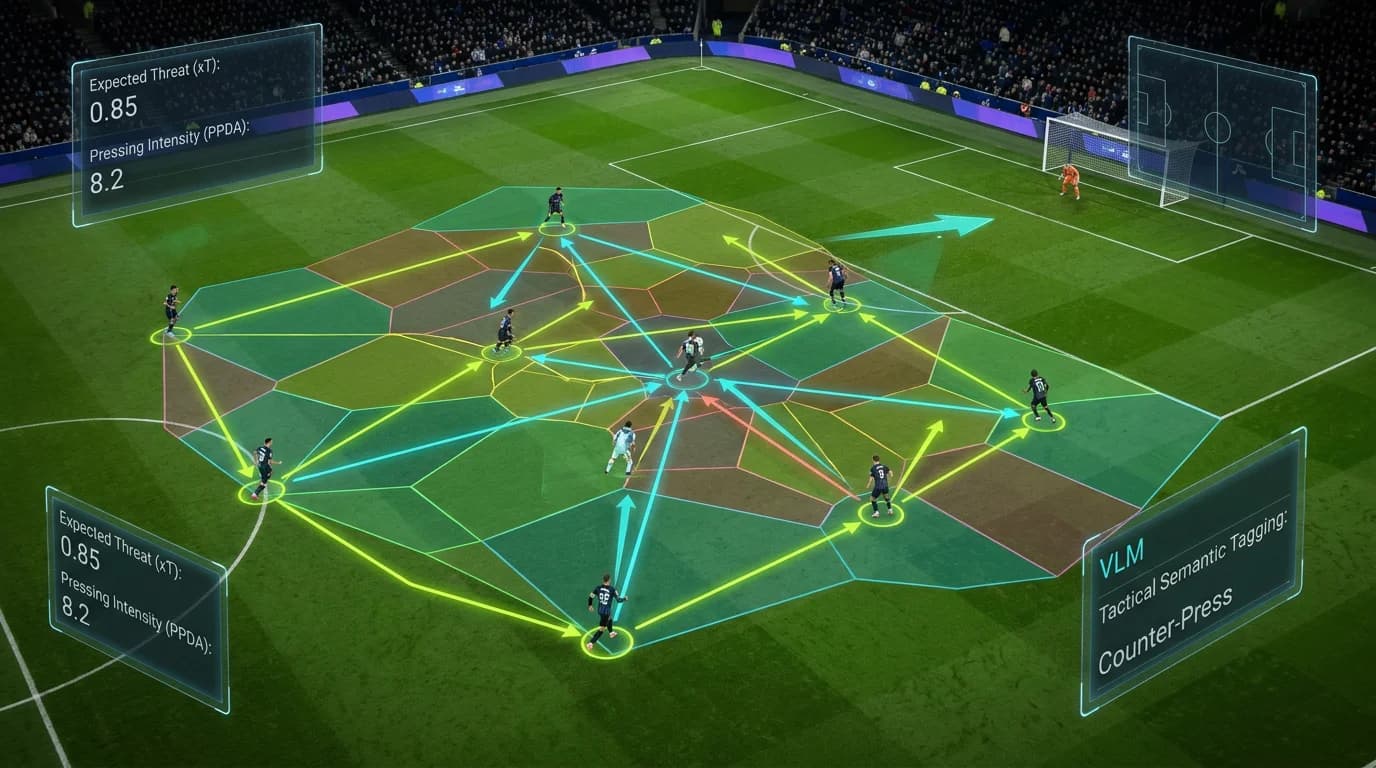
Raw coordinates become actionable when structured as a relational network. Football is inherently an evolving graph where players are nodes and passing channels, defensive covers, and pressing angles form edges.
The TacticAI research published in Nature Communications by Google DeepMind and Liverpool FC illustrates the power of geometric deep learning on corner kicks. Set pieces provide structured environments where small positional changes have significant tactical consequences.
By exploiting pitch reflection symmetries, geometric models treat mirror-image set pieces equivalently. This enables deep neural networks to generalize from limited match samples. The model predicts ball receivers and shot likelihood while generating counterfactual adjustments to minimize defensive vulnerability.
Beyond dead-ball situations, dynamic graph models continuously evaluate pitch control surfaces and Expected Threat. Rather than evaluating whether a pass succeeded, models assess whether a runner movement distorted the opponent defensive block to create space elsewhere.
Geometric deep learning preserves pitch symmetries. Left-side and right-side tactical routines share identical geometric principles, allowing models to learn robust representations without artificial data inflation.
Tier 3: The cognitive layer with VLMs and LLMs
The upper tier bridges calibrated tracking data with coach dialogue through vision-language models and constrained language agents.
Vision-language models interpret match footage semantically. Research such as SoccerNet-GSR and the X-VARS multi-modal refereeing project demonstrate how multimodal architectures can evaluate complex match sequences and provide explainable justifications grounded in game rules.
Constrained language models act as compilers between human language and spatial queries. An analyst asks a tactical question in natural prose. The agent translates the request into structured graph queries over coordinate databases, retrieves candidate video sequences, and generates a concise debrief.
In recruitment, this layer automates scouting dossiers. Instead of presenting scouts with raw percentiles, agentic pipelines synthesize event data, physical workload metrics, and video timestamps into consistent scouting reports calibrated to the club positional profiles.
Production architecture and operational reality
An elite football analytics deployment operates across two distinct latency regimes:
- In-match tactical support: Low-latency inference deployed on stadium hardware delivers critical phase summaries and set-piece alerts within seconds to technical staff.
- Post-match and recruitment analysis: Batch pipelines process multi-camera tactical recordings, synchronizing tracking logs with external event streams for comprehensive squad reviews and opposition scouting.
Every architectural tier maintains strict evidence linkages. A tactical assertion generated by a language model must reference the exact frame timestamps and spatial coordinates from which it was derived. When footage is occluded or ambiguous, the pipeline flags the gap rather than providing a fluent fabrication.
For teams building these pipelines, our work in Sports Video Analytics, Multimodal AI, and Sports Intelligence outlines the operational system around the models.

Why simple AI wrappers fail on the pitch
Sports analytics projects frequently stumble when general-purpose models are deployed without domain grounding. Common pitfalls include:
- Coordinate hallucination: Language models cannot deduce metric Euclidean distance from uncalibrated video frames. Distances and velocities must always be computed by calibrated vision geometry.
- Camera cuts and identity drift: Broadcast cuts disrupt tracking continuity. Production systems use spatio-temporal state graphs and jersey re-identification to preserve player identities across replays.
- Generic tactical definitions: Generic models lack context on a manager tactical principles. Pressing intensity and defensive lines must be configurable to the club specific game model.
- Lack of visual proof: Technical staff will not trust automated recommendations without immediate video verification. Every finding requires a one-click review path back to source footage.
The tactical AI roadmap for elite clubs
Clubs adopting this architecture typically advance through three phased milestones:
- Establish calibrated vision pipelines: Deploy robust camera calibration, multi-object tracking, and top-down minimap projection from dedicated tactical cameras.
- Model spatial dynamics: Integrate relational graph networks, pitch control surfaces, and automated phase detection into a synchronized time-series data store.
- Deploy conversational and multimodal interfaces: Layer vision-language models and retrieval-augmented agents to make spatial archives searchable via natural language.
By treating computer vision as the geometric sensor, graphs as the tactical physics engine, and multimodal models as the semantic interface, clubs turn raw match footage into a decisive competitive advantage.
References
What the sources support
- TacticAI demonstrates predictive and generative AI for football set pieces in Nature Communications. Nature Communications 2024; DOI: 10.1038/s41467-024-45965-x. Peer-reviewed study by Google DeepMind and Liverpool FC on corner kick modeling.
- SoccerNet-GSR establishes benchmark datasets and evaluation methods for game state reconstruction from single-camera football video. CVPR Workshops 2024; arXiv: 2404.11335. Benchmark evaluation on multi-object athlete tracking and minimap localization.
- X-VARS introduces multimodal large language models for explainable decision reasoning in football refereeing. CVPR CVsports 2024; arXiv: 2406.01234. Academic benchmark for multi-view video evaluation and natural language reasoning in sports.
- TacticAI: an AI assistant for football tactics (Nature Communications) — Google DeepMind & Liverpool FC (2024)
- SoccerNet Game State Reconstruction: End-to-End Athlete Tracking and Identification on a Minimap — CVPR Workshops (2024)
- X-VARS: Introducing Explainability in Football Refereeing with Multi-Modal Large Language Models — CVPR CVsports Workshop (2024)